Today's
EarthStation1.com 15% Off Commemorative Memorial Title: An Old
Time Radio Christmas MP3 Set DVD, Audio Download, USB Stick
Today, December 18, 2025
December 18: Bake Cookies Day: -- Just in
time for Christmas, too! Cookies are more than just a baked treat,
with generations bonding over it. What we love best about cookies
is their versatility; crispy or soft and chewy, traditional shapes
or special cookie-cutter designs, sugar, spices, dried fruit,
chocolate, the list of options goes on. So get baking and fill
your house with the aroma of warm, soft cookies baked to
perfection. From simple sugar ones to triple-chocolate ones, we
think cookies are the greatest thing to have come out of an oven
since baked bread. Although the exact origin of the day is
unknown, every year on Bake Cookies Day, people merrily bake
cookies for bake sales, charity drives, and sharing with friends
and family. Cookies have been around in some form or another
pretty much forever. The earliest documented cookie goes back to
seventh-century Persia. Cookies were introduced to America
sometime in the 17th century, but the name 'cookie' was given much
later. The original dutch form 'koekje,' meaning 'small cake' was
altered to 'cooky' and eventually 'cookie.' Since then, they have
taken the world by storm and thanks to the countless flavors,
varieties, and styles, have become a beloved treat for every event
and occasion year-round. Two recipes for cookies debuted in the
first cookbook written by an American that was published in the
United States. 'American Cookery,' authored by Amelia Simmons in
1796, included two recipes; the first titled 'Cookies' and the
other 'Christmas Cookie.' Cookies are one of those few treats you
can make where your imagination is the limit. Bakers with a
creative streak to break the mold have invented some of the most
well-loved cookies we eat today. For example, the chocolate-chip
cookie was invented by Sue Brides and Ruth Graves Wakefield in
1938. The duo owned a popular inn in Massachusetts, featuring
in-house baking that ultimately led them to try something new. On
Sale @ 15% Off Discount Till Midnight PT!
https://store.earthstation1.com/christmas-radio-mp3-dvd-old-time-broadcast-antholog3.html
Today's
EarthStation1.com 15% Off Commemorative Memorial Title: The King
Family TV Show & Christmas Special DVD MP4 Video Download
Today, December 18, 2025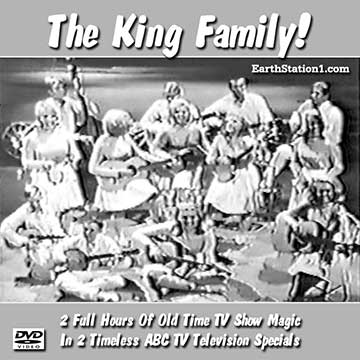
December 18: Flake Appreciation Day: --
This holiday is used to show appreciation for snowflakes which are
loved by many. Snowflakes are beautiful, unique, and naturally
occurring. They come in complex shapes and sizes and are divided
into 35 categories. As with human fingerprints, no two snowflakes
are exactly alike. Snowflakes are created when water vapor in
clouds freezes around dust particles due to humidity. Typically
hexagonal, snowflakes can sometimes take the form of flat,
needle-shaped particles. Snowflakes are a subject of thought and
appreciation on Flake Appreciation Day. The event is celebrated
around December when snow begins to fall in many parts of the
Northern Hemisphere. Snowflakes can be classified into one of 35
different shape groups based on their size and shape. When water
vapor in the clouds condenses into ice crystals, snowflakes
spontaneously appear in nature. Snowflakes' shapes are impacted by
elements like dust, temperature, humidity, and currents. There are
different numbers of water molecules in snowflakes, which cause
them to form a crystal pattern. Because of diffuse reflection,
snowflakes appear white even though they are made of clear ice.
Snowflakes are usually studied by putting a chemical compound on a
glass plate and allowing a flake to land on the plate. The
chemical compound covers the snowflake and hardens. The snowflake
leaves its shape behind after it melts. The history of snowflakes
was greatly influenced by Wilson Bentley. He was born in 1865 in
Jericho, Vermont. His work is significant as he helped discover
that no two snowflakes are exactly alike. He used a type of
photography that uses microscopes called photomicrography to take
pictures of 5,000 snowflakes. Bentley published articles and books
about his findings and donated some of his photographs to the
Smithsonian Institution. He was the world's leading snowflake
expert and was referred to as 'The Snowflake Man' until he died in
1931. On Sale @ 15% Off Discount Till Midnight PT!
https://store.earthstation1.com/a-king-family-christmas-old-time-yuletide-television-special-dvd.html
Today's
EarthStation1.com 15% Off Commemorative Memorial Title:
Immigration To The United States Documentaries DVD, MP4, USB Drive
Today, December 18, 2025
December 18: International Migrants Day:
-- A day to reflect upon the challenges and difficulties faced by
over 272 million migrants courageously building new lives in every
corner of the world. The reality of migration is more than just
starting over. Migrants travel in search of security and
opportunities that will allow them to reinvent themselves. Others
are escaping from discrimination and prejudice. Host societies
need to evolve and welcome these communities for a better
tomorrow. Migration has many factors enforcing it on a global
level. These stem from human necessities for safety, dignity, and
peace. It is never an easy decision to leave home, especially when
the journey ahead is extremely dangerous and, at times, fatal.
Although the day was made official in the year 2000, the
observance of this day goes as far back as the year 1997 when
December 18 was marked as the day to campaign for the respect,
rights, and protection of migrants by several Asian migrant
organizations. On account of the ever-increasing number of
migrants around the world, on December 4, 2000, the United Nations
General Assembly declared December 18 as the day for International
Migrants. A decade prior to this, on the same day, the Assembly
initiated the International Convention on the Protection of the
Rights of All Migrant Workers and Members of Their Families.
During the first-ever summit focused on large-scale movements of
migrants and refugees on September 19, 2016, a fixed set of
commitments - known as the New York Declaration for Refugees and
Migrants - was adopted by the United Nations General Assembly to
enhance the safety of such displaced persons. This declaration
reiterates the essentiality of the international protection regime
and pledges by member states to improve the migration system for
people on the move. The U.N.'s 2030 Agenda for Sustainable
Development also features migration-related goals. These include
access to education, which will lead to better opportunities and a
better quality of life. On Sale @ 15% Off Discount Till Midnight
PT!
https://store.earthstation1.com/immigration-to-the-united-states-dvd.html
Today's
EarthStation1.com 15% Off Commemorative Memorial Title: Hannibal:
The Terror Of Rome Documentary Series MP4 Video Download DVD
Today, December 18, 2025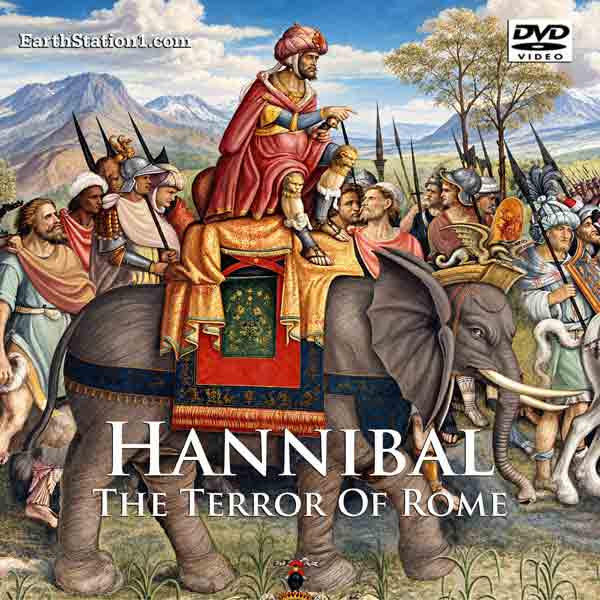
December 18, 218 BC: The Punic Wars: The
Second Punic War (The Hannibalic War): The Battle Of The Trebia
(The Battle Of The Trebbia): -- The first major battle of the
Second Punic War is fought between the Carthaginian forces of
Hannibal and the Roman Republic. It was a resounding Roman defeat
with heavy losses, and yet some 10,000 and more Romans, over 2.5
legions, survived on the field and retreated in order to Placentia
(Piacenza). In this battle, Hannibal got the better of the Romans
by exercising the careful and innovative planning for which he was
famous. The impetuous and short-sighted opposing general, the
consul Tiberius Sempronius Longus, allowed himself to be provoked
into a frontal assault under physically difficult circumstances
and failed to see that he was being led into a trap. The battle
took place in the flat country of the Province of Piacenza on the
left bank of the Trebbia River, a shallow, braided stream, not far
south from its confluence (from the south) with the Po river. The
battle is named for the river. Although the precise location is
not known for certain, it is generally accepted as being visible
from the Via Emilia, now paralleled by highway A21/E70 and a
railroad trunk line, all of which come from Piacenza, a
contemporaneously placed Roman colony. On Sale @ 15% Off Discount
Till Midnight PT!
https://store.earthstation1.com/hannibal-the-terror-of-rome-documentary-series-mp4-video-download-dv4.html
Today's
EarthStation1.com 15% Off Commemorative Memorial Title: Sold Down
The River: Black Freedom Lost After Civil War DVD, MP4, USB
Today, December 18, 2025
December 18, 1865: The Reconstruction Era
(Reconstruction): The Constitution Of The United States: The
Reconstruction Amendments: Slavery In The United States: The End
Of Slavery In The United States: The Thirteenth Amendment To The
United States Constitution (Amendment XIII): -- US Secretary Of
State William Seward proclaims the adoption of the Thirteenth
Amendment, prohibiting slavery throughout the USA. The Thirteenth
Amendment (Amendment XIII) to the United States Constitution
abolished slavery and involuntary servitude, except as punishment
for a crime (punishment called Penal Labor). In Congress, it was
passed by the Senate on April 8, 1864, and by the House on January
31, 1865. The amendment was ratified by the required number of
states on December 6, 1865. On December 18, 1865, Secretary Of
State William H. Seward proclaimed its adoption. It was the first
of the three Reconstruction Amendments adopted following the
American Civil War. On Sale @ 15% Off Discount Till Midnight PT!
https://store.earthstation1.com/sold-down-the-river-black-liberty39s-loss-after-civil-war-dvd-mp4-394.html
Today's
EarthStation1.com 15% Off Commemorative Memorial Title: Joseph
Stalin Documentaries DVD, Video Download, USB Flash Drive
Today, December 18, 2025
December 18, 1878: #BOTD: Joseph Stalin,
Georgian-Russian Soviet revolutionary, marshal and political
leader, General Secretary of the Central Committee of the
Communist Party of the Soviet Union from 1922 to 1952, 4th Premier
of the Soviet Union from 1941 till his death, dictator of the
Soviet Untion from the mid-1920s until his death (d. March 5,
1953) is #born Ioseb Besarionis dze Jughashvili to a working class
family in the Georgian town of Gori, then part of the Tiflis
Governorate of the Russian Empire and home to a mix of Georgian,
Azerbaijanian, Armenian, Russian, and Jewish communities. Joseph
Vissarionovich Stalin, iIdeologically a Marxist and a Leninist,
helped to formalise these ideas as Marxism-Leninism while his own
policies became known as Stalinism. to a working class familyAs a
youth Stalin joined the Marxist Russian Social Democratic Labour
Party. He edited the party newspaper Pravda and raised funds for
Vladimir Lenin's Bolshevik faction via robberies, kidnappings, and
protection rackets. Repeatedly arrested, he underwent several
internal exiles. After the Bolsheviks gained power in the October
Revolution of 1917 and established the Russian Soviet Republic,
Stalin sat on the governing Politburo during the Russian Civil War
and helped form the Soviet Union in 1922. Despite Lenin's
opposition, Stalin consolidated power following the former's death
in 1924. During Stalin's tenure, "Socialism in One Country"
became a central concept in Soviet society, and Lenin's New
Economic Policy was replaced with a centralised command economy,
industrialisation and collectivisation. These rapidly transformed
the country into an industrial power, but disrupted food
production and contributed to the famine of 1932-33, particularly
affecting Ukraine. To eradicate those regarded as "enemies of
the working class", from 1934 to 1939 Stalin organised the
"Great Purge" in which hundreds of thousands - including
senior political and military figures - were interned in prison
camps, exiled, or executed. Stalin's government promoted
Marxism-Leninism abroad through the Communist International and
supported anti-fascist movements throughout Europe during the
1930s, particularly in the Spanish Civil War. However, in 1939
they signed a non-aggression pact with Nazi Germany, resulting in
their joint Invasion Of Poland. Germany ended the pact by invading
the Soviet Union in 1941. Despite initial setbacks, the Soviet Red
Army halted the German incursion and captured Berlin in May 1945,
ending World War II in Europe. The Soviets annexed the Baltic
states and helped establish pro-Soviet Marxist-Leninist
governments throughout Eastern Europe. The Soviet Union and the
United States emerged as the two world superpowers, and a period
of tensions began between the Soviet-backed Eastern Bloc and
U.S.-backed Western Bloc known as the Cold War. Stalin led his
country through its post-war reconstruction, during which it
developed a nuclear weapon. In these years, the country
experienced another major famine and a period of antisemitism,
which reached its peak in the 1952-1953 Doctors' plot. Stalin died
on March 5, 1953 at the age of 74 in his Volynskoe Dacha in
Kuntsevo, Moscow of a cerebral hemorrhage. It is possible that
Stalin was murdered. Lavrentiy Beria, Stalin's NKVD secret police
chief, has been suspected of murder, although no firm evidence has
ever appeared. Stalin's death was announced on March 6. The body
was embalmed, and then placed on display in Moscow's House of
Unions for three days. Crowds were such that a crush killed about
100 people. The funeral involved the body being laid to rest in
Lenin's Mausoleum in Red Square on March 9; hundreds of thousands
attended. That month featured a surge in arrests for "anti-Soviet
agitation" as those celebrating Stalin's death came to police
attention. The Chinese government instituted a period of official
mourning for Stalin's death. Stalin was succeeded by Nikita
Khrushchev, who denounced his predecessor and initiated a
de-Stalinisation process throughout Soviet society. Widely
considered one of the 20th century's most significant figures,
Stalin was the subject of a pervasive personality cult within the
international Marxist-Leninist movement, for whom Stalin was a
champion of socialism and the working class. Since the fall of the
Soviet Union, Stalin has retained popularity in Russia and Georgia
as a victorious wartime leader who established the Soviet Union as
a major world power. Conversely, his autocratic government has
been widely denounced for overseeing mass repressions, hundreds of
thousands of executions and millions of non-combatant deaths
through his policies. On Sale @ 15% Off Discount Till Midnight PT!
https://store.earthstation1.com/joseph-stalin-documentaries-dvd.html
Today's
EarthStation1.com 15% Off Commemorative Memorial Title: The Great
Depression 7 Part Documentary Series MP4 Video Download DVD
Today, December 18, 2025
December 18, 1888: #BOTD: Robert Moses, dominant American urban planner and public official of the New York metropolitan area whose grand-scale infrastructure projects and philosophy of urban development influenced a generation of engineers, architects, and urban planners across America, designer of the Northern State Parkway and Southern State Parkway, organizer of the 1964 New York World's Fair (d. July 29, 1981) is #born in New Haven, Connecticut to German Jewish parents; Moses was raised in a secularist manner inspired by the Ethical Culture movement of the late 19th century, and later converted to Christianity. Despite never being elected to any office, Moses is regarded as one of the most powerful individuals in the history of the New York City and New York State governments. Moses held various positions throughout his more than forty-year long career, holding up to 12 titles simultaneously, including New York City Parks Commissioner and Chairman of the Long Island State Park Commission. He created and led numerous semi-autonomous public authorities, through which he controlled millions of dollars in revenue and directly issued bonds to fund new ventures with little outside input or oversight (having worked closely with New York Governor Al Smith early in his career, Moses became expert in writing laws and navigating and manipulating the inner workings of state government). Moses's projects transformed the New York area and revolutionized the way cities in the U.S. were designed and built. As Long Island State Park Commissioner, Moses oversaw the construction of Jones Beach State Park, the most visited public beach in the United States, and was the primary architect of the New York State Parkway System. As head of the Triborough Bridge Authority, Moses had near-complete control over bridges and tunnels in New York City as well as the tolls collected from them, and built, among others, the Triborough Bridge, the Brooklyn-Battery Tunnel, and the Throgs Neck Bridge, as well as several major highways. These roadways and bridges, alongside urban renewal efforts that saw the destruction of huge swaths of tenement housing and their replacement with large public housing projects, transformed the physical fabric of New York and inspired other cities to undertake similar development endeavors. Robert Moses died of heart disease at the age of 92 at Good Samaritan Hospital in West Islip, New York. He was interred in a crypt in an outdoor community mausoleum in Woodlawn Cemetery in The Bronx, New York City following services at St. Peter's by-the-Sea Episcopal Church in Bay Shore, New York. Although he was well-regarded throughout most of his career, Moses's reputation was damaged with the publication of Robert Caro's Pulitzer Prize-winning biography The Power Broker (1974). Casting doubt on the supposed benefits of many of Moses's projects, The Power Broker painted a picture of Moses as a power-hungry and vindictive man who was not above questionable ethics and wielded excessive power. Caro's book further cast Moses as racist, highlighting the damage to black and other minority communities inflicted by many of Moses's urban renewal and highway construction projects. In large part because of The Power Broker, Moses is today considered a controversial figure in the history of New York City. On Sale @ 15% Off Discount Till Midnight PT! https://store.earthstation1.com/grde7padosem.html
Today's
EarthStation1.com 15% Off Commemorative Memorial Title: Spike
Jones Nutcracker Suite Complete 3 Record Set MP3 CD Download
Today, December 18, 2025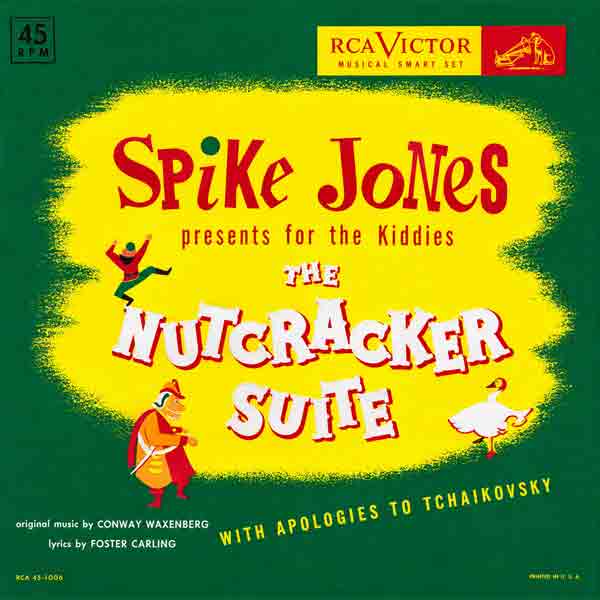
December 18, 1892: Aesthetics: Performing
Arts: Premieres: Theatre Premieres: Dance: Dance Premieres:
Concert Dance (Performance Dance, Theatre Dance): Concert Dance
(Performance Dance, Theatre Dance) Premieres: Ballet: Ballet
Premieres: Russian Ballet Premieres: -- The Nutcracker by Pyotr
Ilyich Tchaikovsky is given its premiere performance at the
Mariinsky Theatre in Saint Petersburg, Russia on a Sunday,
double-billed with Tchaikovsky's opera Iolanta. The Nutcracker is
a two-act ballet, originally choreographed by Marius Petipa and
Lev Ivanov which Tchaikovsky scored. The libretto is adapted from
E. T. A. Hoffmann's story "The Nutcracker and the Mouse
King", adapted from the Alexandre Dumas story "The
Nutcracker". Although the original production was not a
success, the 20-minute suite that Tchaikovsky extracted from the
ballet was. However, the complete Nutcracker has enjoyed enormous
popularity since the late 1960s and is now performed by countless
ballet companies, primarily during the Christmas season,
especially in North America. Major American ballet companies
generate around 40% of their annual ticket revenues from
performances of The Nutcracker. Tchaikovsky's score has become one
of his most famous compositions, in particular the pieces featured
in the suite. Among other things, the score is noted for its use
of the celesta, an instrument that the composer had already
employed in his much lesser known symphonic ballad The Voyevoda.
On Sale @ 15% Off Discount Till Midnight PT!
https://store.earthstation1.com/spike-jones-nutcracker-suite-all-3-45-rpm-records-mp3453.html
Today's
EarthStation1.com 15% Off Commemorative Memorial Title: Armed
Forces Radio Presents Jubilee! WWII Radio DVD, MP3 Download, USB
Today, December 18, 2025
December 18, 1897: #BOTD: #HBD! Fletcher
Henderson, also known as Smack Henderson because of smacking
sounds he made with his lips, African American jazz pioneer, swing
music pioneer, pianist, bandleader, arranger and composer, a
seminal figure with vast influence in the development of big band
jazz and swing music and the ultimately the evolution of big band
music (d. December 29, 1952) is #born James Fletcher Hamilton
Henderson in Cuthbert, Georgia. He was one of the most prolific
black musical arrangers and, along with Duke Ellington, is
considered one of the most influential arrangers and bandleaders
in jazz history, and helped bridge the gap between the Dixieland
and the swing eras. Fletcher Henderson's father, Fletcher Hamilton
Henderson (1857-1943), was the principal of the nearby Howard
Normal Randolph School from 1880 until 1942. His home, now known
as the Fletcher Henderson House, is a historic site. His mother, a
teacher, taught him and his brother Horace to play the piano. He
began lessons by the age of six. His father would occasionally
lock Fletcher in his room to practice for hours. By age 13,
Henderson possessed a keen ability to read music and sense pitch.
He pursued the studies with his mother and further engaged himself
in lessons on European art. Although a talented musician,
Henderson decided to dedicate himself to math and science. He
attended Atlanta University (where he was a member of the
fraternity Alpha Phi Alpha) and graduated in 1920 with a
bachelor's degree in chemistry and mathematics. After graduation,
he moved to New York City with the intention of attending Columbia
University for a master's degree in chemistry. In New York City,
Henderson shared an apartment with a pianist who worked as a
musician in a riverboat orchestra. When his roommate was too sick
to perform, Henderson took his place, which soon gave him a job as
a full-time replacement. In the fall of 1920 he found work as a
song demonstrator with the Pace and Handy Music Co. Henderson now
found that music would be more profitable than chemistry and left
his job as a lab chemist to begin a life in music. When Pace left
the company to start Black Swan Records, he took Henderson with
him to be musical director, a job which lasted from 1921-1923.
From 1920-1923, he primarily played piano accompaniment for blues
singers. Henderson toured with the Black Swan Troubadours
featuring Ethel Waters from October 1921 to July 1922. After
hearing Louis Armstrong in New Orleans while on tour in April
1922, Henderson sent him an offer, but Armstrong refused because
Henderson would not hire Zutty Singleton as well. In July 1924 the
band began a brief engagement at the Roseland Ballroom. Although
only meant to stay for a few months, the band was brought back for
the autumn season. Henderson called on the 23-year-old cornetist
Louis Armstrong for a second time to join the band. Henderson's
offer on October 13, 1924 made history when the Henderson band
began their re-engagement at Roseland with Armstrong now in the
orchestra. Quickly the band became known as the best African
American band in New York. By late 1924 the arrangements by Don
Redman were featuring more solo work. In addition to adding hot
solos to arrangements, Redman arranged Armstrong's repertoire with
the King Oliver's Creole Jazz Band, such as turning "Dippermouth
Blues" into "Sugar Foot Stomp." Armstrong played in
the band for only a year because he could not grow accustomed to
the arrangements and to the "pretension" of the other
band members. Despite this, his influence on the Henderson band
and all jazz during this time cannot be overstated. Through his
hot solos, knowledge of jazz repertoire, and introduction of
clarinetist Buster Bailey to the band, Armstrong turned
Henderson's Orchestra into a jazz band. Henderson's band boasted
the formidable arranging talents of Don Redman. After Redman's
departure from the band in 1927, Henderson took on some of the
arranging, but Benny Carter was Redman's replacement as saxophone
player and arranger from 1930-31, and Henderson also bought scores
from freelance musicians (including John Nesbitt from McKinney's
Cotton Pickers). Henderson developed his arranging skills from
1931 to the mid-1930s. His band c. 1925 included Howard Scott,
Coleman Hawkins (who started with Henderson in 1923, playing the
tuba parts on a bass saxophone, and quickly moving to tenor
saxophone and a leading solo role), Louis Armstrong, Charlie
Dixon, Kaiser Marshall, Buster Bailey, Elmer Chambers, Charlie
Green, Ralph Escudero, and Don Redman. In 1925, with Henry Troy,
he wrote "Gin House Blues", recorded by Bessie Smith and
Nina Simone among others. His other compositions include "Soft
Winds". Henderson recorded extensively in the 1920s for
nearly every label, including Vocalion, Paramount, Columbia,
Olympic, Ajax, Pathe, Perfect, Edison, Emerson, Brunswick, and the
dime-store labels Banner, Oriole, Regal, Cameo, and Romeo. From
1925-1930, he recorded primarily for Columbia and Brunswick/
Vocalion under his own name and a series of acoustic recordings as
the Dixie Stompers for Harmony Records and associated dime-store
labels (Diva and Velvet Tone). During the 1930s, he recorded for
Columbia, Crown (as "Connie's Inn Orchestra"), ARC
(Melotone, Perfect, Oriole, Vocalion), Bluebird, Victor, and
Decca. Starting in the early 1920s, he recorded popular hits and
jazz tunes. In 1924 he and his band recorded 80 sides. His version
of the pop tune "I Can't Get the One I Want", recorded
about June 19, 1924, was issued on at least 23 labels. In addition
to Armstrong, lead trumpeters included Henry "Red"
Allen, Joe Smith, Rex Stewart, Tommy Ladnier, Doc Cheatham and Roy
Eldridge. Lead saxophonists included Coleman Hawkins, Buster
Bailey, Benny Carter and Chu Berry. Sun Ra also worked as an
arranger during the 1940s, during Henderson's engagement at the
Club DeLisa in Chicago. Sun Ra said that on first hearing
Henderson's orchestra as a teenager he assumed that they were
angels because no human could produce such beautiful music.
Although Henderson's band was popular, he had little success in
managing it. His lack of recognition outside of Harlem had to do
more with the times in which he lived, apparently lackluster
management, and the hard times that resulted after the 1929 stock
market crash. Fletcher had a knack for finding talent, but he did
not have much luck keeping it. On many occasions he lost talented
members to other bandleaders. He also had trouble with finances.
When the band split up in 1934, he was forced to sell some of his
popular arrangements to Benny Goodman to keep them together. After
about 1931, his own arrangements became influential. In addition
to arrangements for his band, he wrote arrangements for Teddy
Hill, Isham Jones and Benny Goodman. His shoulder was injured in
an auto accident in 1928. His wife, Leora, blamed the accident for
his diminishing success. She said that John Hammond and Goodman
bought Henderson's arrangements to support him, that Goodman
always gave Henderson credit for the arrangements and said that he
played them better than his own. In addition, Goodman and Hammond
organized broadcasts and recordings to help Henderson when he was
ill. Four decades later, two of his songs, "Queer Notions"
and "Yeah, Man!" were performed in the movie Kansas
City. In 1935, Goodman's Orchestra was selected as a house band
for the NBC radio program Let's Dance. Since Goodman needed new
charts every week for the show, his friend John Hammond suggested
that he purchase some from Henderson. Many of Goodman's hits from
the swing era were played by Henderson and his own band in the
late 1920s and early 1930s, usually as head arrangements, which he
transcribed from his own records and then sold to Goodman.
However, his brother Horace Henderson recounted (in Ross
Firestone's biography of Goodman, Swing, Swing, Swing) that the
clarinetist made heavy demands on Henderson for fresh charts while
his band was engaged for the Let's Dance show in 1934-35, and that
he himself helped his brother complete some of them. The singer
Helen Ward also stated that Henderson was delighted to hear the
Goodman Orchestra realize his creations with such impeccable
musicianship. In 1939, Henderson disbanded his band and joined
Goodman's, first as pianist and arranger and then working
full-time as staff arranger. He re-formed bands of his own several
times in the 1940s and toured with Ethel Waters again in
1948-1949. Henderson suffered a stroke in 1950, resulting in
partial paralysis that ended his days as a pianist. He died in New
York City in 1952, eleven days after his 55th birthday. He is
buried in Greenwood Cemetery in Cuthbert, Georgia. Henderson,
along with Don Redman, established the formula for swing music.
The two broke the band into sections (sax section, trumpet
section, etc). These sections worked together to create a unique
sound. Sometimes, the sections would play in call-and-response
style, and at other times one section would play supporting riffs
behind the other. Swing, its popularity spanning over a decade,
was the most fashionable form of jazz ever in the United States.
Henderson was also responsible for bringing Louis Armstrong from
Chicago to New York in October 1924, thus flipping the focal point
of jazz in the history of the United States (although Armstrong
left the band in November 1925 and returned to Chicago). Henderson
also played a key role in bringing improvisatory jazz styles from
New Orleans and other areas of the country to New York, where they
merged with a dance-band tradition that relied heavily on
arrangements written out in musical notation. A museum is being
established in his memory in Cuthbert, Georgia. Henderson differed
from other musicians in his time. He made the idea of playing jazz
exclusively popular to ambitious, young, black musicians. He made
it financially stable and a way to seize cultural power during the
time. Henderson was genuine when it came to the appearance of the
band. He was all for making an impact on the era. Henderson would
intently see to it that each member had a clean-shaven face, a
tuxedo, and polished shoes. It was recorded that he would do this
before every performance, especially ones in predominantly white
communities, such as Times Square. Henderson created a band that
was capable of playing dance music and complex arrangements. Louis
Metcalf said, "The sight of Fletcher Henderson's men playing
behind music stands brought on a learning-to-read-music kick in
Harlem which hadn't cared before it. There were two years of real
concentration. Everybody greeted you with 'How's studying?'"
On Sale @ 15% Off Discount Till Midnight PT!
https://store.earthstation1.com/armed-forces-radio-presents-jubilee-otr-jazz-music-mp3-dv3.html
Today's
EarthStation1.com 15% Off Commemorative Memorial Title: WWII
Films: African Americans At War Films Set DVD, MP4, USB Drive
Today, December 18, 2025
December 18, 1912: #BOTD: #HBD: Benjamin
O. Davis Jr., African American commander of the Tuskegee Airmen
99th Fighter Squadron and the 332nd Fighter Group, which escorted
bombers on air combat missions over Europe during World War II,
who flew sixty bomber escort missions in P-39, P-40, P-47 and P-51
Mustang fighters and was one of the first African American pilots
to see combat, becoming the first African American general in the
U.S. Air Force on May 22, 1959 (d. July 4, 2002) is #born Benjamin
Oliver Davis Jr. in Washington, D.C., the second of three children
born to Elnora Dickerson Davis and Benjamin O. Davis Sr., who was
himself the first African American general in the United States
Army. He was advanced to four-star general by President Bill
Clinton on December 9, 1998. Benjamin O. Davis Jr. died at age 89
of Alzheimer's disease at Walter Reed Army Medical Center in
Washington, D.C. He was interred with his wife Agatha on July 17,
at Arlington National Cemetery. A Red Tail P-51 Mustang, similar
to the one he had flown in World War II, flew overhead during his
funeral service. Bill Clinton said, "General Davis is here
today as proof that a person can overcome adversity and
discrimination, achieve great things, turn skeptics into
believers; and through example and perseverance, one person can
bring truly amazing change". On Sale @ 15% Off Discount Till
Midnight PT!
https://store.earthstation1.com/wwii-films-africanamericans-at-war-dvd.html
Today's
EarthStation1.com 15% Off Commemorative Memorial Title: Verdun!
World War I Battle Film & Documentaries Collection DVD MP4 USB
Today, December 18, 2025
December 18, 1916: The European Civil
War: World War I: The First European War (The European Theater Of
World War I): The Western Front Of World War I: The Battle Of
Verdun (French: Bataille De Verdun; German: Schlacht Um Verdun):
-- The largest and longest battle of the First World War on the
Western Front between the German and French armies concludes when
German forces under Chief Of Staff Erich Von Falkenhayn are
defeated by the French, ending The Battle Of Verdun. After ten
months of fighting, 543,000 French and 434,000 German soldiers
were killed, virtually 1 million dead on both sides in less than a
year, at merely the midpoint of the terribly bloody First World
War. The Battle Of Verdun (French: Bataille de Verdun; German:
Schlacht um Verdun) was fought from February 21, 1916 to December
18, 1916 on the Western Front in France. The battle was the
longest of the First World War and took place on the hills north
of Verdun-sur-Meuse. Using the experience of the Second Battle of
Champagne in 1915, the Germans planned to capture the Meuse
Heights, an excellent defensive position with good observation for
artillery-fire on Verdun. The Germans hoped that the French would
commit their strategic reserve to recapture the position and
suffer catastrophic losses at little cost to the Germans. By March
6, 20 1/2 French divisions were in the RFV and a more extensive
defence in depth had been constructed. Philippe Petain ordered no
retreat and that German attacks were to be counter-attacked,
despite this exposing French infantry to German artillery-fire. By
March 29, French guns on the west bank had begun a constant
bombardment of Germans on the east bank, causing many infantry
casualties. The German offensive was extended to the left (west)
bank of the Meuse, to gain observation and eliminate the French
artillery firing over the river but the attacks failed to reach
their objectives. The battle lasted for 302 days, the longest and
one of the most costly in human history, with the French suffering
some 377K casualties and the Germans 337K, an average of 70K a
month. On Sale @ 15% Off Discount Till Midnight PT!
https://store.earthstation1.com/verdun-world-war-one-battle-dvd.html
Today's
EarthStation1.com 15% Off Commemorative Memorial Title: Going
Hollywood: The War Years U.S. WWII Cinema DVD Download USB
Today, December 18, 2025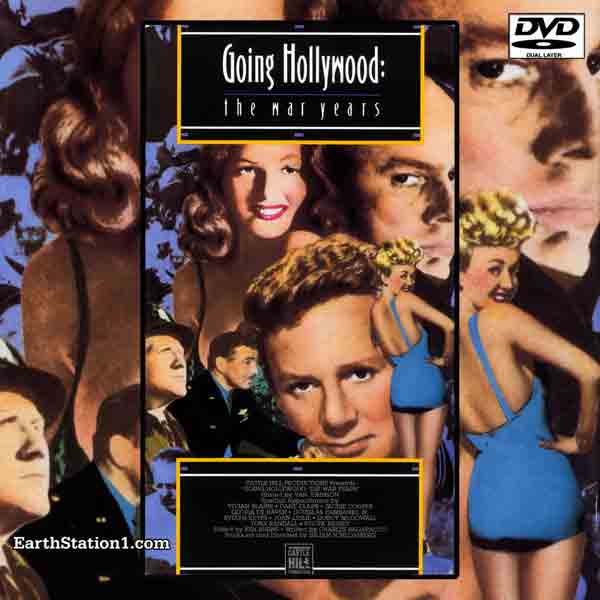
December 18, 1916: #BOTD: #HBD! Betty
Grable, pin-up girl, dancer, model, singer, sex symbol and beauty,
whose legs were considered ideally beautiful, and remain a
standard by which the beauty of other women's legs are judged (d.
July 2, 1973) is #born Elizabeth Ruth Grable in St. Louis,
Missouri, the youngest of three children of Lillian Rose (nee
Hofmann; 1889-1964) and John Conn Grable (1883-1954), a
stockbroker. She was of Dutch, English, German, and Irish
ancestry. Nicknamed "Betty" as a child, she was
pressured by her mother to become a performer. She was entered in
multiple beauty contests, many of which she won or for which she
achieved considerable attention. Despite her success, she suffered
from a fear of crowds and sleepwalking. Betty Grable's 42 films
during the 1930s and 1940s grossed more than 100M USD. For 10
consecutive years (1942-1951) she reigned in the Quigley Poll's
Top 10 box office stars (a feat only matched by Doris Day and
Barbra Streisand). The U.S. Treasury Department in 1946 and 1947
listed her as the highest-salaried American woman; she earned more
than 3M USD during her career. Grable began her film career in
1929 at age 12, after which she was fired from a contract when it
was learned she signed up under false identification. She had
contracts with RKO and Paramount Pictures during the 1930s, and
appeared in a string of B movies, mostly portraying college
students. Grable came to prominence in the Broadway musical
DuBarry Was a Lady (1939), which brought her to the attention of
20th Century-Fox. She replaced Alice Faye in Down Argentine Way
(1940), her first major Hollywood film, and became Fox's biggest
film star throughout the remaining decade. Fox cast Grable in a
succession of Technicolor musicals during the decade that were
immensely popular, co-starring with such leading men as Victor
Mature, Don Ameche, John Payne, and Tyrone Power. In 1943, she was
the number-one box-office draw in the world and, in 1947, she was
the highest-paid entertainer in the United States. Two of her
biggest film successes were the musical Mother Wore Tights (1947)
and the comedy How to Marry a Millionaire (1953), one of her last
films. Grable retired from screen acting in 1955 after she
withdrew from her Fox contract, although she continued to perform
on the stage and on television. Throughout her career, Grable was
a celebrated sex symbol. Her bathing suit poster made her the
number-one pin-up girl of World War II, surpassing Rita Hayworth.
It was later included in the Life magazine project "100
Photographs That Changed the World". Hosiery specialists of
the era often noted the ideal proportions of her legs as thigh
(18.5 in (47 cm)), calf (12 in (30 cm)), and ankle (7.5 in (19
cm)). Grable's legs were insured by her studio for 1M USD as a
publicity stunt. Describing her film career, Grable said "I
became a star for two reasons, and I'm standing on them." In
1943, she collaborated with photographer Frank Powolny for a
regular studio photo session. During the shoot, she took several
photos in a tight, one-piece bathing suit. One particular pose
consisted of Grable's back being to the camera as she playfully
smiled looking over her right shoulder, showing off her "Million
Dollar Legs"; the reason for this pose was the fact that she
was in fact several months pregnant with her first child. The
picture was released as a poster and became the most requested
photo for G.I.s stationed overseas. Grable's photograph sold
millions of copies, eventually surpassing the popularity of Rita
Hayworth's famous 1941 photo. Betty Grable died of lung cancer at
the age of 56 in Santa Monica, California. Her funeral was held
two days later and was attended by ex-husbands Jackie Coogan and
Harry James as well as Hollywood stars Dorothy Lamour, Shirley
Booth, Mitzi Gaynor, Don Ameche, Cesar Romero, George Raft, Alice
Faye, Johnnie Ray and Dan Dailey. "I Had the Craziest Dream",
the ballad from Springtime in the Rockies, was played on the
church organ. She is entombed at Inglewood Park Cemetery in
Inglewood, California. On Sale @ 15% Off Discount Till Midnight
PT!
https://store.earthstation1.com/going-hollywood-the-war-years-us-wwii-cinema-dvd-download-usb-drive.html
Today's
EarthStation1.com 15% Off Commemorative Memorial Title: Haiti:
Killing The Dream 1991 Haitian Coup + Bonus MP4 Download DVD
Today, December 18, 2025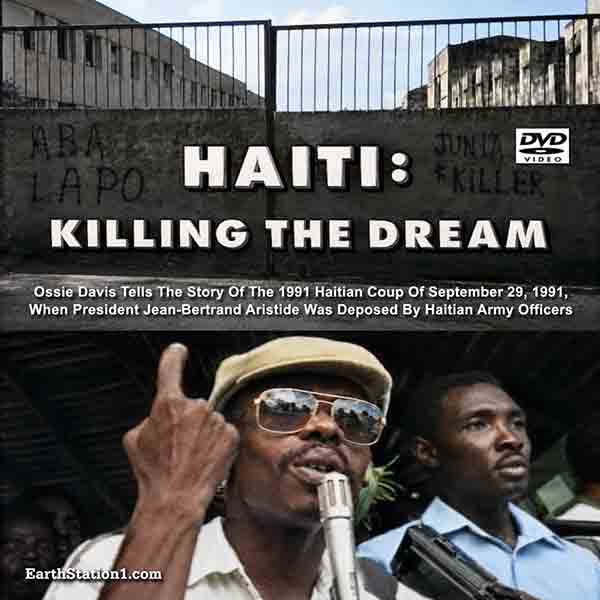
( #JCKaelin here: It should be no
surprise to those in the know what was signified by "R.C."
in "R.C. Davis" ;) ) ========= December 18, 1917: #BOTD:
#HBD! Ossie Davis, African American actor, activist and Freemason
(d. February 4, 2005) is #born Raiford Chatman Davis in Cogdell,
Georgia, he was the son of Kince Charles Davis, a railway
construction engineer, and his wife Laura (nee Cooper). He
inadvertently became known as "Ossie" when his birth
certificate was being filed and his mother's pronunciation of his
name as "R. C. Davis" was misheard by the courthouse
clerk in Clinch County, Ga. Davis experienced racism from an early
age when the KKK threatened to shoot his father, whose job they
felt was too advanced for a black man to have. His siblings
included scientist William Conan Davis, social worker Essie Morgan
Davis, pharmacist Kenneth Curtis Davis, and biology teacher James
Davis. Ossie Davis was an American film, television and Broadway
actor, director, poet, playwright, author, and civil rights
activist. He was married to Ruby Dee, with whom he frequently
performed, until his death in 2005. He and his wife were named to
the NAACP Image Awards Hall of Fame; were awarded the National
Medal of Arts and were recipients of the Kennedy Center Honors. He
was inducted into the American Theater Hall of Fame in 1994. Davis
died at the age of 87 in a Miami hotel room. An official cause of
death was not released, but he was known to have had heart
problems. His remains were cremated, and his ashes are held in the
same urn as that of his beloved wife Ruby Dee, with the
inscription "In this thing together". Their shared urn
is buried at Ferncliff Cemetery in Hartsdale, New York. On Sale @
15% Off Discount Till Midnight PT!
https://store.earthstation1.com/haiti-killing-the-dream-the-1991-haitian-coup-dvd-download1991.html
Today's
EarthStation1.com 15% Off Commemorative Memorial Title: Air Power
WWII TV Series With Walter Cronkite DVD, Video Download, USB
Today, December 18, 2025
December 18, 1939: The European Civil
War: World War II: The Second European War (The European Theater
Of World War II): The Western Front Of World War II: Aviation:
Military Aviation: Air Warfare Of World War II: The Defence Of The
Reich (German: Reichsverteidigung): The Battle Of The Heligoland
Bight (1939): -- The first major air battle of the war, takes
place over The Heligoland Bight, also known as Helgoland Bight, a
bay which forms the southern part of the German Bight, itself a
bay of the North Sea, located at the mouth of the Elbe river. It
was the first "named" air battle of the Second World
War, and it began the longest air campaign of the war, the Defence
of the Reich, the name given to the strategic defensive aerial
campaign fought by the Luftwaffe over German-occupied Europe and
Nazi Germany during World War II. A force of three RAF bomber
squadrons were sent to engage German ships in the Heligoland Bight
and sink or damage as many as possible. Originally 24 Vickers
Wellingtons took off. Two turned back owing to engine trouble
before reaching German airspace. The United Kingdom had declared
war on Nazi Germany after the German Invasion Of Poland which
began World War II. The British did not assist Poland by land or
sea, but over the ensuing weeks, RAF Bomber Command flew several
missions against German targets. A number of these air raids were
directed at Kriegsmarine (German Navy) warships in German ports to
prevent their use in the Battle of the Atlantic. With the front
lines static between September 1939 and May 1940, a period known
as the "Phoney War" set in, with little fighting on land
or in the air. However, at sea, German U-boat (submarine) forces
were taking a considerable toll on Allied shipping. The Air
Ministry decided to launch an attack on German surface ships to
prevent them supporting the U-boats in the North Atlantic, and so
began The Battle Of The Heligoland Bight. The German reaction was
slow. Eventually they scrambled strong fighter aircraft forces to
intercept. Just over 120 aircraft, 80-100 German and 22 British,
were involved but only 44 German fighters made contact with the
British bombers. The Germans inflicted more damage on the RAF than
the Luftwaffe received, but its influence on both sides' future
strategy was profound. The battle forced the RAF to abandon
daylight missions in favour of night bombing as casualties were
too high. In the build-up to the war, the RAF had adopted the
mantra that "the bomber will always get through"; but in
daylight the Heligoland battle had shown this was not the case and
it forced a reappraisal of future bombing operations. The failure
of the raid led the Luftwaffe to believe its base in Germany
proper was invulnerable to enemy attack. This belief was
reinforced with the Wehrmacht's success in 1939-1941, which meant
that opposing air forces were then too far away for effective
bombing attacks on the German homeland. Neglecting their day
fighter force had serious strategic consequences in later years.
By the time the Oberkommando der Luftwaffe (OKL; Luftwaffe High
Command) had begun organising an air defence to combat the United
States Army Air Forces (USAAF) strategic bombing campaign, they
were already engaged in a war of attrition for which they were not
prepared. This oversight was one of the contributing factors in
the defeat of the Luftwaffe in the Defence of the Reich campaign.
The German official history called the battle "amongst the
most important actions of the entire war". On Sale @ 15% Off
Discount Till Midnight PT!
https://store.earthstation1.com/air-power-original-1950s-tv-series-walter-cronkite-4-dv19504.html
Today's
EarthStation1.com 15% Off Commemorative Memorial Title: Operation
Barbarossa: Nazi Invasion Of Russia + Bonus MP4 Download DVD
Today, December 18, 2025
December 18, 1940: The European Civil
War: World War II: The Second European War (The European Theater
Of World War II): The Eastern Front Of World War II: The Great
Patriotic War (The German-Soviet War): Operation Barbarossa: --
Adolf Hitler orders the German General Staff to begin planning
Operation Barbarossa (German: Unternehmen Barbarossa), the German
invasion of the Soviet Union. It began six months later, when at
3:15 am on June 22, 1941, some 3.2 million German soldiers plunged
headlong into Russia across an 1800-mile front, in a major turing
point of World War II. At 7 am that morning, a proclamation from
Hitler to the German people announced, "At this moment a
march is taking place that, for its extent, compares with the
greatest the world has ever seen...". Operation Barbarossa
stemmed from Hitler's ideological aims to conquer the western
Soviet Union so that it could be repopulated by Germans, to use
Slavs, especially Poles, as a slave-labour force for the Axis war
effort, and to seize the oil reserves of the Caucasus and the
agricultural resources of Soviet territories. In the two years
leading up to the invasion, Germany and the Soviet Union signed
political and economic pacts for strategic purposes. Nevertheless,
the German High Command began planning an invasion of the Soviet
Union in July 1940 (under the codename Operation Otto), which
Adolf Hitler authorized on 18 December 1940. Over the course of
the operation, about four million Axis powers personnel, the
largest invasion force in the history of warfare, invaded the
western Soviet Union along a 2,900-kilometer (1,800 mi) front. In
addition to troops, the Wehrmacht employed some 600,000 motor
vehicles, and between 600,000 and 700,000 horses for non-combat
operations. The offensive marked an escalation of the war, both
geographically and in the formation of the Allied coalition.
Operationally, German forces achieved major victories and occupied
some of the most important economic areas of the Soviet Union,
mainly in the Ukrainian Soviet Socialist Republic, and inflicted,
as well as sustained, heavy casualties. Despite these Axis
successes, the German offensive stalled in The Battle Of Moscow
and the subsequent Soviet winter counteroffensive pushed German
troops back. The Red Army absorbed the Wehrmacht's strongest blows
and forced the unprepared Germans into a war of attrition. The
Wehrmacht never again mounted a simultaneous offensive along the
entire Eastern front. The failure of the operation drove Hitler to
demand further operations of increasingly limited scope inside the
Soviet Union, such as Case Blue in 1942 and Operation Citadel in
1943 - all of which eventually failed. The failure of Operation
Barbarossa proved a turning point in the fortunes of the Third
Reich. Most importantly, the operation opened up the Eastern
Front, in which more forces were committed than in any other
theater of war in world history. The Eastern Front became the site
of some of the largest battles, most horrific atrocities, and
highest casualties for Soviet and Axis units alike, all of which
influenced the course of both World War II and the subsequent
history of the 20th century. The German armies captured 5,000,000
Red Army troops, who were denied the protection guaranteed by the
Hague Conventions and the 1929 Geneva Convention. A majority of
Red Army POWs never returned alive. The Nazis deliberately starved
to death, or otherwise killed, 3.3 million prisoners, as well as a
huge number of civilians through the "Hunger Plan" that
aimed at largely replacing the Slavic population with German
settlers. Einsatzgruppen death squads and gassing operations
murdered over a million Soviet Jews as part of the Holocaust. On
Sale @ 15% Off Discount Till Midnight PT!
https://store.earthstation1.com/operation-barbarossa-dvd-german-invasion-of-russia-wwii.html
Today's
EarthStation1.com 15% Off Commemorative Memorial Title: 25x5: The
Continuing Adventures Of The Rolling Stones DVD, MP4, USB
Today, December 18, 2025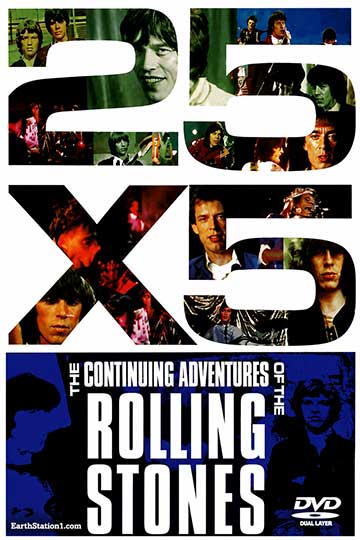
December 18, 1943: #BOTD: #HBD! Keith
Richards, English singer, songwriter, guitarist and producer, best
known as the co-founder, guitarist, secondary vocalist, and
co-principal songwriter of the Rolling Stones, is #born at
Livingston Hospital, in Dartford, Kent, England. Rolling Stone
magazine called Richards the creator of "rock's greatest
single body of riffs" on guitar and ranked him fourth on its
list of 100 best guitarists in 2011. The magazine lists fourteen
songs that Richards wrote with the Rolling Stones' lead vocalist
Mick Jagger on its "Rolling Stone's 500 Greatest Songs of All
Time" list. Richards plays both lead and rhythm guitar parts,
often in the same song, as the Stones are generally known for
their guitar interplay of rhythm and lead ("weaving")
between Richards and the other guitarist in the band - Brian Jones
(1962-1969), Mick Taylor (1969-1975), and Ronnie Wood
(1975-present). In the recording studio, Richards sometimes plays
all of the guitar parts, notably on the songs "Paint It
Black", "Ruby Tuesday", "Sympathy for the
Devil", and "Gimme Shelter". He is also a vocalist,
singing backing vocals on many Rolling Stones songs as well as
occasional lead vocals, such as on the Rolling Stones' 1972 single
"Happy", as well as with his side project, the X-Pensive
Winos. On Sale @ 15% Off Discount Till Midnight PT!
https://store.earthstation1.com/25x5-the-continuing-adventures-of-the-rolling-stones-dvd-mp42554.html
Today's
EarthStation1.com 15% Off Commemorative Memorial Title: WWII
Films: Japanese Internment Films About Japan MP4 Download DVD Set
Today, December 18, 2025
( #J.C. Kaelin here: Although the
particular rationale that I am about to describe for the
internment of Japanese Americans was never specifically
articulated, I have personally concluded that it was actually
intended to obtain hostages of Japanese ancestry to use to induce
Imperial Japan not to mistreat the some 1.5 million prisoners and
internees of European ancestry that they had thusfar obtained
since the war began on December 7, with the intention of
preventing the further torture, inhumane treatment and abuse that
they were reportedly being subjected to during their captivity by
the Japanese. - J. C. Kaelin, December 18, 2023.) =========
December 18: 1944: World War II: The United States Home Front
During World War II: The Pacific War (The Asia-Pacific War, The
Asiatic-Pacific Theater, The Pacific Theater Of World War II): The
History Of Asian Americans: The History of Japanese Americans: The
Internment Of Japanese Americans: Korematsu v. United States: --
The Supreme Court of the United States issues its landmark
decision in Korematsu v. United States: it supports Franklin D.
Roosevelt's Executive Order 9066 which cleared the way for the
incarceration of nearly all 120,000 Japanese Americans, two-thirds
of whom were U.S. citizens, born and raised in the United States
that were located in the West Coast Military Area (The West Coast
Of The United States, also known as The Pacific Coast, The Pacific
Seaboard, and the Western Seaboard, which included the contiguous
U.S. states of California, Oregon, and Washington, as well as the
American territories [now states] of Alaska and Hawaii) during
World War II. The decision has been widely criticized, with some
scholars describing it as "an odious and discredited artifact
of popular bigotry", and as "a stain on American
jurisprudence". The case is often cited as one of the worst
Supreme Court decisions of all time. Chief Justice John Roberts
repudiated the Korematsu decision in his majority opinion in the
2018 case of Trump v. Hawaii. In the aftermath of Imperial Japan's
attack on Pearl Harbor, President Franklin D. Roosevelt had issued
Executive Order 9066 on February 19, 1942, authorizing the U.S.
War Department to create military areas from which any or all
Americans might be excluded. Subsequently, the Western Defense
Command, a U.S. Army military command charged with coordinating
the defense of the West Coast of the United States, ordered "all
persons of Japanese ancestry, including aliens and non-aliens"
to relocate to internment camps. However, a 23-year-old
Japanese-American man, Fred Korematsu, refused to leave the
exclusion zone and instead challenged the order on the grounds
that it violated the Fifth Amendment. In a majority opinion joined
by five other justices, Associate Justice Hugo Black held that the
need to protect against espionage by Japan outweighed the rights
of Americans of Japanese ancestry. Black wrote that "Korematsu
was not excluded from the Military Area because of hostility to
him or his race", but rather "because the properly
constituted military authorities...decided that the military
urgency of the situation demanded that all citizens of Japanese
ancestry be segregated from the West Coast" during the war
against Japan. Dissenting justices Frank Murphy, Robert H.
Jackson, and Owen J. Roberts all criticized the exclusion as
racially discriminatory; Murphy wrote that the exclusion of
Japanese "falls into the ugly abyss of racism" and
resembled "the abhorrent and despicable treatment of minority
groups by the dictatorial tyrannies which this nation is now
pledged to destroy." The Korematsu opinion was the first
instance in which the Supreme Court applied the strict scrutiny
standard of review to racial discrimination by the government; it
is one of only a handful of cases in which the Court held that the
government met this standard. Korematsu's conviction was voided by
a California district court in 1983 on the grounds that Solicitor
General Charles H. Fahy had suppressed a report from the Office of
Naval Intelligence which stated there was no evidence that
Japanese Americans were acting as spies for Japan. The
Japanese-Americans who were interned were later granted
reparations through the Civil Liberties Act of 1988. On Sale @ 15%
Off Discount Till Midnight PT!
https://store.earthstation1.com/wwii-films-japanese-internment-and-us-films-about-japan-dvd.html
Today's
EarthStation1.com 15% Off Commemorative Memorial Title: Apartheid
Documentaries Collection DVD, Video Download, USB Drive
Today, December 18, 2025
December 18, 1946: #BOTD: #HBD! Steve
Biko, Black South African civil rights leader and anti-apartheid
activist, founder of the Black Consciousness Movement (d.
September 12, 1977)) is #born Bantu Stephen Biko in Tarkastad,
Eastern Cape. Steve Biko gained international recognition when he
died in police detention from injuries sustained during his August
18 arrest at a police roadblock under the Terrorism Act No. 83 of
1967 in King William' Town, South Africa for bringing attention to
South Africa's apartheid policies. Ideologically an African
nationalist and African socialist, Steve Biko was at the forefront
of a grassroots anti-apartheid campaign known as the Black
Consciousness Movement during the late 1960s and 1970s. His ideas
were articulated in a series of articles published under the
pseudonym Frank Talk. Raised in a poor Xhosa family, Biko grew up
in Ginsberg township in the Eastern Cape. In 1966, he began
studying medicine at the University of Natal, where he joined the
National Union Of South African Students (NUSAS). Strongly opposed
to the apartheid system of racial segregation and white-minority
rule in South Africa, Biko was frustrated that NUSAS and other
anti-apartheid groups were dominated by white liberals, rather
than by the blacks who were most affected by apartheid. He
believed that even when well-intentioned, white liberals failed to
comprehend the black experience and often acted in a paternalistic
manner. He developed the view that to avoid white domination,
black people had to organise independently, and to this end he
became a leading figure in the creation of the South African
Students' Organisation (SASO) in 1968. Membership was open only to
"blacks", a term that Biko used in reference not just to
Bantu-speaking Africans but also to Coloureds and Indians. He was
careful to keep his movement independent of white liberals, but
opposed anti-white racism and had various white friends and
lovers. The white-minority National Party government were
initially supportive, seeing SASO's creation as a victory for
apartheid's ethos of racial separatism. Influenced by Frantz Fanon
and the African American Black Power movement, Biko and his
compatriots developed Black Consciousness as SASO's official
ideology. The movement campaigned for an end to apartheid and the
transition of South Africa toward universal suffrage and a
socialist economy. It organised Black Community Programmes (BCPs)
and focused on the psychological empowerment of black people. Biko
believed that black people needed to rid themselves of any sense
of racial inferiority, an idea he expressed by popularizing the
slogan "black is beautiful". In 1972, he was involved in
founding the Black People's Convention (BPC) to promote Black
Consciousness ideas among the wider population. The government
came to see Biko as a subversive threat and placed him under a
banning order in 1973, severely restricting his activities. He
remained politically active, helping organise BCPs such as a
healthcare centre and a creche (day care center) in the Ginsberg
area. During his ban he received repeated anonymous threats, and
was detained by state security services on several occasions.
Following his arrest in August 1977, Biko died age 30 while in
police detention from injuries sustained during his August 18
arrest at a police roadblock under the Terrorism Act No. 83 of
1967 in King William' Town, South Africa for bringing attention to
South Africa's apartheid policies. He is buried at King William's
Town Cemetery in King William's Town, Buffalo City Metropolitan
Municipality, Eastern Cape, South Africa. Over 20,000 people
attended his funeral. Biko's fame spread posthumously; he became
the subject of numerous songs and works of art, while a 1978
biography by his friend Donald Woods formed the basis for the 1987
film Cry Freedom. During Biko's life, the government alleged that
he hated whites, various anti-apartheid activists accused him of
sexism, and African racial nationalists criticised his united
front with Coloureds and Indians. Nonetheless, Biko became one of
the earliest icons of the movement against apartheid, and is
regarded as a political martyr and the "Father of Black
Consciousness". His political legacy remains a matter of
contention. On Sale @ 15% Off Discount Till Midnight PT!
https://store.earthstation1.com/apartheid-documentaries-dvd-racial-segregation-in-south-africa.html
Today's
EarthStation1.com 15% Off Commemorative Memorial Title: Japan: A
Cherry Blossom By Many Other Names MP4 Video Download DVD
Today, December 18, 2025
December 18, 1956: World War II: The
Pacific War (The Asia-Pacific War, The Asiatic-Pacific Theater,
The Pacific Theater Of World War II): The Aftermath Of World War
II: The Aftermath Of The Pacific War: Japan: The History Of Japan:
Foreign Relations Of Japan: -- Japan is granted membership in the
United Nations. After the war, Japan adopted a new constitution in
1947 emphasizing liberal democratic practices, and The Allied
Occupation Of Japan ended with The Treaty Of San Francisco in
1952. A period of record growth propelled Japan to become the
second-largest economy in the world; this ended after the popping
of The Japanese Asset Price Bubble of 1986-1991, beginning The
Lost Decade (Japanese: Ushinawareta Junen) of the 1990s, becoming
The Lost Decades when was it was successively renamed The Lost 20
Years in the 2000s and The Lost 30 Years in the 2010s. Japan now
has the world's fourth-largest economy by nominal GDP, after that
of the United States, China and Germany, and the fifth-largest
economy by PPP-adjusted GDP. Japan is one of the G4 countries
seeking reform of the Security Council. Japan is a member of the
G7, APEC, and "ASEAN Plus Three", and is a participant
in the East Asia Summit. It is the world's fifth-largest donor of
official development assistance, donating 9.2B USD in 2014. In
2024, Japan had the fourth-largest diplomatic network in the
world. Japan has close economic and military relations with the
United States, with which it maintains a security alliance. The
United States is a major market for Japanese exports and a major
source of Japanese imports, and is committed to defending the
country, with military bases in Japan. In 2016, Japan announced
the Free and Open Indo-Pacific vision, which frames its regional
policies. Japan is also a member of the Quadrilateral Security
Dialogue ("the Quad"), a multilateral security dialogue
reformed in 2017 aiming to limit Chinese influence in the
Indo-Pacific region, along with the United States, Australia, and
India. Japan is engaged in several territorial disputes with its
neighbors. Japan contests Russia's control of the Southern Kuril
Islands, which were occupied by the Soviet Union in 1945. South
Korea's control of the Liancourt Rocks is acknowledged but not
accepted as they are claimed by Japan. Japan has strained
relations with China and Taiwan over the Senkaku Islands and the
status of Okinotorishima. Japan is the third highest-ranked Asian
country in the 2024 Global Peace Index. It spent 1.1% of its total
GDP on its defence budget in 2022, and maintained the
tenth-largest military budget in the world in 2022. The country's
military (the Japan Self-Defense Forces) is restricted by Article
9 of the Japanese Constitution, which renounces Japan's right to
declare war or use military force in international disputes. The
military is governed by the Ministry of Defense, and primarily
consists of the Japan Ground Self-Defense Force, the Japan
Maritime Self-Defense Force, and the Japan Air Self-Defense Force.
The deployment of troops to Iraq and Afghanistan marked the first
overseas use of Japan's military since World War II. On Sale @ 15%
Off Discount Till Midnight PT!
https://store.earthstation1.com/japan-a-cherry-blossom-by-many-other-names-mp4-video-download-dvd.html
Today's
EarthStation1.com 15% Off Commemorative Memorial Title: Universal
Newsreels: The Space Race Films DVD MP4 Download USB Drive
Today, December 18, 2025
December 18, 1958: Rocket Launches: The
History Of Rocketry: The History Of Spaceflight: The Aftermath Of
World War II: The Cold War: Communications Satellites: SCORE
(Signal Communications By Orbiting Relay Equipment): -- Project
SCORE, the world's first communications satellite, is launched at
23:02:00 GMT atop an Atlas-B (The Convair SM-65B Atlas, The X-12)
launch vehicle from Cape Canaveral Launch Complex 11 (LC-11).
SCORE provided a first test of a communications relay system in
space, as well as the first successful use of the Atlas as a
launch vehicle. It captured world attention by broadcasting a
Christmas message via short wave radio from U.S. President Dwight
D. Eisenhower through an on-board tape recorder. The satellite was
popularly dubbed "The Talking Atlas". SCORE, as a
geopolitical strategy, placed the United States at an even
technological par with the Soviet Union as a highly functional
response to the Sputnik 1 and Sputnik 2 satellites. On Sale @ 15%
Off Discount Till Midnight PT!
https://store.earthstation1.com/universal-newsreels-the-space-race-films-dvd-mp4-download-usb-driv4.html
Today's
EarthStation1.com 15% Off Commemorative Memorial Title: War Jets:
The Boeing B-52 Stratofortress DVD, MP4 Download, USB Stick
Today, December 18, 2025
December 18, 1972: The Aftermath Of World
War II: The Cold War: The Cold War In Asia: The Indochina Wars:
The Vietnam War (The Second Indochina War, The Vietnam Conflict,
The Resistance War Against America): The United States In The
Vietnam War: Aerial Operations And Battles Of The Vietnam War:
Strategic Bombing During The Vietnam War: Operation Linebacker II
(The December Raids, The Christmas Bombings): -- President Richard
Nixon announces that the United States will engage North Vietnam
with a series of aerial bombings after peace talks with them
collapsed on Deccember 13. Operation Linebacker II was a maximum
effort bombing campaign to "destroy major target complexes in
the Hanoi and Haiphong areas, which could only be accomplished by
B-52s". It saw the largest heavy bomber strikes launched by
the US Air Force since the end of World War II. The bombing would
continue until December 29th, when the North Vietnamese agreed to
accept a number of American proposals and resume negotiations. On
Sale @ 15% Off Discount Till Midnight PT!
https://store.earthstation1.com/war-jets-the-boeing-b52-stratofortress-d52.html
Today's
EarthStation1.com 15% Off Commemorative Memorial Title: Props And
Jets: Soviet Air Power Order Of Battle DVD, Download, USB
Today, December 18, 2025
December 18, 1981: Aviation: The History
Of Aviation: The History Of Military Aviation: Maiden Flights:
Military Aviation Maiden Flights: -- First flight of the Russian
heavy strategic bomber The Tupolev Tu-160 (Russian: Belyj Lebed,
"White Swan", NATO reporting name: Blackjack). As of
2022, it is the world's largest and heaviest combat aircraft, the
largest and heaviest Mach 2+ supersonic military aircraft ever
built, the fastest bomber in use, the largest and heaviest
variable-sweep wing airplane ever flown, and second only to the
United States Air Force's North American XB-70 Valkyrie prototype
B-70 supersonic strategic bomber in overall length. Designed by
the Tupolev Design Bureau in the Soviet Union in the 1970s, it
entered service in 1987, and was the last strategic bomber
designed for the Soviet Union. As of 2016, the Russian Air Force's
Long Range Aviation branch had 16 aircraft in service. The Tu-160
active fleet has been undergoing upgrades to electronics systems
since the early 2000s. The Tu-160M modernization program of
existing models began with the first updated aircraft delivered in
December 2014. In January 2022 the first serial built aircraft had
its test flight, with two planned for delivery in 2022 from 10 on
order, plans that ultimately include 50 new Tu-160M bombers and
upgrading 16 existing aircraft. On Sale @ 15% Off Discount Till
Midnight PT!
https://store.earthstation1.com/props-and-jets-soviet-air-power-cold-war-order-of-battle-dvd.html
Today's
EarthStation1.com 15% Off Commemorative Memorial Title: Who Built
Stonehenge? Documentary DVD, MP4 Download, USB Flash Drive
Today, December 18, 2025
December 18, 2011: Archaeology
(Archeology): Prehistoric Monuments: Stone Age Britain: Megaliths:
Stone Circles: Stone Circles In The British Isles And Brittany:
Henges: Stonehenge: -- Geologists from University of Leicester and
the National Museum of Wales announce the discovery of the exact
source of some of the rhyolite fragments found in the Stonehenge
debitage; these fragments, however, do not seem to match any of
the standing stones or bluestone stumps. The researchers have
identified the source as a 230-foot (70 m) long rock outcrop
called Craig Rhos-y-Felin, near Pont Saeson in north
Pembrokeshire, located 140 miles from Stonehenge. Stonehenge is a
prehistoric monument in Wiltshire, England, two miles (3 km) west
of Amesbury. It consists of a ring of standing stones, each around
13 feet (4.0 m) high, seven feet (2.1 m) wide, and weighing around
25 tons. The stones are set within earthworks in the middle of the
most dense complex of Neolithic and Bronze Age monuments in
England, including several hundred tumuli (burial mounds).
Archaeologists believe it was constructed from 3000 BC to 2000 BC.
The surrounding circular earth bank and ditch, which constitute
the earliest phase of the monument, have been dated to about 3100
BC. Radiocarbon dating suggests that the first bluestones were
raised between 2400 and 2200 BC, although they may have been at
the site as early as 3000 BC. One of the most famous landmarks in
the United Kingdom, Stonehenge is regarded as a British cultural
icon. It has been a legally protected Scheduled Ancient Monument
since 1882, when legislation to protect historic monuments was
first successfully introduced in Britain. The site and its
surroundings were added to UNESCO's list of World Heritage Sites
in 1986. Stonehenge is owned by the Crown and managed by English
Heritage; the surrounding land is owned by the National Trust.
Stonehenge could have been a burial ground from its earliest
beginnings. Deposits containing human bone date from as early as
3000 BC, when the ditch and bank were first dug, and continued for
at least another 500 years. On Sale @ 15% Off Discount Till
Midnight PT!
https://store.earthstation1.com/who-built-stonehenge-dvd-horizon.html
Today's
EarthStation1.com #OnThisDay Commemorative Memorial Title:
Universal Newsreels Video Super Mega Set DVD, MP4 Download, USB
Stick
Today, December 18, 2025 December 18: National Twin Day: --
Celebrates all the siblings who enjoy the unique connection
because they share a birthday. Whether fraternal or identical,
twins share everything right from the beginning. While their
personalities may be different, they often know what the other is
going to say before the words are spoken. Distance isn't an issue
either. Twins manage to stay connected across the country or
around the globe. Of course, mythology teaches us about twins from
the very beginning, as does the Bible. From the rivalry of Esau
and Jacob to Aphrodite's twin sons Phobos and Deimos as well as
the mortal and immortal twins of the constellation, Gemini, we
explore a host of human conditions. Through the years, we've been
fascinated by twins, too. Literature embraced the twin duplicity
with enthusiasm. Take Shakespeare's Twelfth Night, for example,
and the confusion that ensues with Sebastian and Viola. Even
modern-day sitcoms keep us in tears when twins are portrayed.
Phoebe Buffay of the sitcom Friends and, more recently, Sheldon
Cooper from The Big Bang Theory humorously depicted their twin
lives. But real-life twins intrigue us, too. When twins move into
the White House, we are sure to pay attention, as was the case
with Barbara and Jenna Bush in 2001. Of course, when they play
magical characters like James and Oliver Phelps did in the Harry
Potter series, we feel like they're family. Their roles as Fred
and George Weasley kept us coming back for more. Some twins have
the same interests. For example, Mark and Scott Kelly both became
astronauts and have contributed not only to space exploration but
also to scientific study. Twins Jocelyne Lamoureux-Davidson and
Monique Lamoureux's love of hockey brought them together on the
U.S. Olympic Hockey Team. Twins share so much more than DNA. Many
of them don't even look alike. One thing is for sure, they share
National Twin Day!
https://store.earthstation1.com/complete-universal-newsreels-dvd-collection-10-dual-layer-dv10.html
Today's
EarthStation1.com #OnThisDay Commemorative Memorial Title:
Suleyman The Magnificent: Documentary On Suleiman I DVD, Download,
USB
Today, December 18, 2025December 18: Arabic Language Day: --
Dating back more than a millennium, Arabic was born out of
Proto-Semitic languages of the ancient Middle East. Today, it's
spoken by more than 400 million people in 25 countries. Arabic
speakers gave us some of civilization's most important tools,
including algebra, chemistry, and the toothbrush. Arabs had a
strong influence on European music, culture, and science. Can't
live without coffee? You can thank the Yemenis of the 9th century
for bringing it to you! One of the world's most ancient languages
and the sixth most commonly spoken in the world, Arabic originated
in the Proto-Semitic languages of the Middle East in the 7th
century. The word "Arab" means "nomad,"
hinting at the language's roots in the nomadic tribes of today's
Arabian Peninsula. Most of our knowledge of Classical Arabic comes
from the Qur'an, Islam's holy book. The scripture is the first
major record of the written Arabic language and provides valuable
insight into the structure of the old language. Today, over one
billion Muslims study Arabic in order to read the Qur'an in its
original tongue. Like other Semitic languages, Arabic is written
from right to left and contains some sounds that don't exist in
English or other languages. Arabic's beautiful "alphabet"
isn't an alphabet at all, at least not in the phonetic sense we're
used to. In the abjad writing system, each symbol stands for a
consonant, with accents providing the vowel sounds. Instead of
capital letters, emphasis is created through the use of quotation
marks. Most words are constructed from a basic, thematically
related root. All words related to writing, for example, contain
the letters "k, t, b," augmented with additional word
parts. In this way, you can understand a word's category in the
world by studying its root. Although learning Arabic might
challenge the average English speaker, we can thank Arabic for a
number of important and useful English words: algebra, alcohol,
coffee, loofah, tariff, cotton, and many more English words come
from Arabic roots. On December 18, 1993, the United Nations
recognized Arabic as one of six official UN languages,
acknowledging its importance and widespread use throughout the
world.
https://store.earthstation1.com/suleyman-the-magnificent-dvd-sultan-of-the-ottoman-empire.html
Today's
EarthStation1.com #OnThisDay Commemorative Memorial Title: Crime
Inc.: The True Story Of The Mafia TV Series DVD, MP4, USB Stick
Today, December 18, 2025December 18: National Crime Junkie Day:
-- Obsessed with true crime? Congratulations, you've found your
holiday AND your fellow crime junkies, for this a day for true
crime enthusiasts to come together and embrace their fascination
with the chilling and complex world of real-life mysteries. Crime
junkies immerse themselves in the details of notorious crimes, and
investigate motives, clues, and theories. The day highlights the
collective curiosity about criminal psychology, unsolved cases,
and the pursuit of justice. True crime has always fascinated
people because it offers a deep dive into the darker side of human
nature and taps into our curiosity about what motivates criminals,
concerns about the legal system, and uncovering shocking or
mysterious events. It captures the complexity of criminal
investigations, the psychological profiles of offenders, and the
quest for justice-it's a captivating and thought-provoking form of
entertainment. Since the late 1980s, shows and documentaries
centering around real-life crimes have captivated audiences. The
rise of true crime podcasts in the 2010s further fueled this
fascination and offered listeners a more accessible way to explore
the genre. In 2017, a podcast was created to fill a gap in the
true crime genre-one focused on captivating storytelling and
making a real impact. With a mission to bring attention to
underrepresented cases, the show quickly grew in popularity and in
2022, National Crime Junkie Day was established to celebrate the
passion of true crime enthusiasts.
https://store.earthstation1.com/crime-inc-the-true-story-of-the-mafia-dvd-set-2-disc2.html
Today's
EarthStation1.com #OnThisDay Commemorative Memorial Title: Rock &
Roll An Unruly History 10 Part TV Series MP4 Video Download DVD
Today, December 18, 2025December 18, 1938: #BOTD: #HBD! Chas
Chandler of The Animals, English musician, record producer and
manager, best known as the original bassist in The Animals, for
which he was inducted into The Rock And Roll Hall Of Fame in 1994
(d. July 17, 1996) is #born Bryan James Chandler in Heaton,
Newcastle. After leaving school, he worked as a turner in the
Tyneside shipyards. He became the bass player with The Alan Price
Trio in 1962. After Eric Burdon joined the band, the Alan Price
Trio was renamed The Animals. Chandler's bass lines were rarely
given critical attention but some, including the opening riff of
the group's 1965 hit "We Gotta Get Out of This Place"
subsequently received praise. Chandler was also the most prominent
of the group's backing vocalists and did occasional songwriting
with Burdon. In 1966, despite commercial success, Chandler became
disillusioned with the lack of money, recalling that, "We
toured non-stop for three years, doing 300 gigs a year and we
hardly got a penny." After The Animals underwent personnel
changes in 1966, Chandler turned to becoming a talent scout,
artist manager, and record producer. During his final tour with
The Animals, Chandler saw a then-unknown Jimi Hendrix play in Cafe
Wha?, a Greenwich Village, New York City nightclub. At the time
Hendrix was performing under the name Jimmy James. In September,
Chandler convinced Hendrix to accompany him to Britain, which was
made possible with the help of Michael Jeffery, who suggested that
he revert to his actual name, and later suggested naming the band
the Jimi Hendrix Experience. In Britain, Chandler recruited
bassist Noel Redding and drummer Mitch Mitchell as the other
members of the Experience. His enthusiasm fuelled Hendrix during
the early days, but halfway through the recording of his third
album in 1968, Electric Ladyland, much had changed within the
band's framework. Chandler was a key figure in Hendrix's rise to
critical and commercial success. Chandler provided the young
musician with living accommodations and financed the Experience's
first single "Hey Joe", before they had a recording
contract. He was also instrumental in introducing Hendrix to Eric
Clapton. It was through this introduction that Hendrix was given
the opportunity to play with Clapton and Cream on stage. It was
Chandler's idea for Hendrix to set his guitar on fire, which made
national news when this idea was used at a concert at the Finsbury
Park Astoria Theatre and subsequently at the Monterey Pop
festival. Hendrix's sound engineer Eddie Kramer later recalled
that Chandler was very hands-on with the first two Hendrix albums,
adding that "he was his mentor and I think it was very
necessary." By 1968, Chandler had become frustrated with the
recording sessions for Hendrix's album Electric Ladyland, claiming
they were self-indulgent. He left management services in the hands
of Jeffery during the following year. Chandler then managed and
produced the British rock band Slade for 12 years, during which
they achieved six number one chart hits in the UK. Chandler and
Slade parted company following the failure of the "Knuckle
Sandwich Nancy" single in May 1981. He would, however
negotiate their RCA contract which lasted for four new albums.
Chandler bought IBC Studios which he renamed Portland Recording
Studios, after the studio address of 35 Portland Place, London and
ran it for four years until he sold it to Don Arden. Chandler also
ran a series of record labels from the studios including Barn
Records, Six of the Best and Cheapskate Records. He formed a music
publishing agency, as well as a production company and management
companies. He also had a brief stint in which he produced the
Philadelphia-based rock group Horsepower, founded by Michael James
Kennedy in 1978. In 1977, Chandler played and recorded with The
Animals during a brief reunion and he joined them again for a
further revival in 1983, at which point he sold his business
interests, in order to concentrate on being a musician. During the
early 1990s, he helped finance the development of Newcastle Arena,
a 10,000 seat sports and entertainment venue which opened in 1995.
Chas Chandler died of an aortic aneurysm aged 57 at Newcastle
General Hospital in Newcastle, England, days after performing a
solo show. He is buried at Preston Cemetery And Tynemouth
Crematorium in North Shields, Metropolitan Borough of North
Tyneside, Tyne and Wear, England. Chandler's former home at 35
Second Avenue, Heaton, hosts a blue plaque placed on the wall by
Newcastle City Council, which reads: "Chas Chandler
1938-1996. Founder member of the 'Animals'. Manager of Jimi
Hendrix & Slade. Co-founder of Newcastle Arena. Lived in this
house 1938-1964."
https://store.earthstation1.com/rock-amp-roll-an-unruly-history-10-part-tv-series-mp4-video-download-104.html
Today's
EarthStation1.com #OnThisDay Commemorative Memorial Title: The
Compleat Beatles Documentary Film DVD, MP4 Download, Flash Drive
Today, December 18, 2025December 18, 1931: #BOTD: #HBD! Allen
Klein, American businessman, music publisher, talent agent,
writers representative, filmmaker and record label executive, most
noted for his tough persona and aggressive, innovative negotiation
tactics, many of which established higher industry standards for
compensating recording artists, founder of ABKCO Music &
Records Incorporated (d. July 4, 2009) is #born in Newark, New
Jersey, the fourth child and only son of Jewish immigrants. Klein
revolutionized the income potential of recording artists, who
previously had been routinely victimized by onerous record company
contracts. He first scored massive monetary and contractual
windfalls for Buddy Knox and Jimmy Bowen, one-hit rockabillies of
the late 1950s, then parlayed his early successes into a position
managing Sam Cooke, and eventually managed the Beatles and the
Rolling Stones simultaneously, along with many other artists,
becoming one of the most powerful individuals in the music
industry during his era. Allen Klein died of respiratory failure
in New York City, aged 77. Yoko Ono and Sean Ono Lennon attended
Klein's funeral. His remains were cremated; the final disposition
of his ashes are not publicly disclosed. Andrew Loog Oldham
commented at a subsequent memorial service that Klein had greatly
magnified the success of the Rolling Stones.
https://store.earthstation1.com/the-compleat-beatles-documentary-dvd.html
Today's
EarthStation1.com #OnThisDay Commemorative Memorial Title: The
Rise And Fall Of Ceausescu Documentary DVD, Download, USB Drive
Today, December 18, 2025December 18, 1989: The Aftermath Of World
War II: The Cold War: The Cold War (1985-1991) (The End Of The
Cold War): The Dissolution Of The Soviet Union: The Revolutions Of
1989 (The Fall Of Nations, The Autumn Of Nations, The Fall Of
Communism): The Eastern Bloc (The Communist Bloc, The Socialist
Bloc, The Soviet Bloc): The Romanian Revolution (The Christmas
Revolution): -- Romanian President Nicolae Ceausescu departs for a
state visit to Iran, irresponsibly leaving to his subordinates and
his wife the duty of dealing with the Timisoara revolt. The day
prior, the Romanian Revolution began to spread from there, where
an attempt by the government to evict dissident Hungarian pastor
Laszlo Tokes on trumped up charges of inciting ethnic hatred
caused members of his ethnic Hungarian congregation to his
apartment in a show of support, throughout the country as Romanian
students spontaneously joined the demonstration, protests which
soon lost nearly all connection to its initial cause and became a
more general anti-government demonstration. Upon President
Ceausescu's return to Romania on the evening of December 20, the
situation became even more tense. In response, he gave a televised
speech from the TV studio inside the Central Committee Building
(CC Building), in which he spoke about the events at Timisoara in
terms of an "interference of foreign forces in Romania's
internal affairs" and an "external aggression on
Romania's sovereignty." The country, which had little to no
information of the events transpiring in Timisoara from the
national media, learned about the revolt from radio stations (such
as Voice Of America and Radio Free Europe) and by word of mouth.
The day after that speech, December 21, Ceausescu staged a mass
meeting in Bucharest. Official media presented it as a
"spontaneous movement of support for Ceausescu",
emulating the 1968 meeting in which he had spoken against the
invasion of Czechoslovakia by Warsaw Pact forces. That disastrous
speech, during which the staged meeting's participants universally
turned against him, was to become his last, and he and his regime
would be overthrown the following day, ultimately culminating in
the drumhead trial and execution him and his wife Elena, ending 42
years of Communist rule in Romania. The Romanian Revolution
(Romanian: Revolutia Romana), also known as The Christmas
Revolution (Romanian: Revolutia de Craciun)), was part of the
Revolutions of 1989 that occurred in several countries around the
world. It was the last removal of a Marxist-Leninist government in
a Warsaw Pact country during the events of 1989, and the only one
that violently overthrew a country's leadership and executed its
leader. According to estimates, over one thousand people died and
thousands more were injured.
https://store.earthstation1.com/the-rise-and-fall-of-ceausescu-dvd.html
Today's
EarthStation1.com #OnThisDay Commemorative Memorial Title:
Watergate: The Secret Story With Mike Wallace DVD MP4 USB Flash
Drive
Today, December 18, 2025December 18, 2008: #DOTD: #RIP: Mark
Felt, now best known as the anonymous source "Deep Throat",
who provided Washington Post reporters Bob Woodward and Carl
Bernstein with critical information about the Watergate Scandal,
American lawyer, law enforcement officer and agent of the Federal
Bureau of Investigation (FBI) from 1942 to 1973, 2nd Deputy
Director of the Federal Bureau of Investigation, the Bureau's
second-highest-ranking post (b. August 17, 1913) #dies in his
sleep at his home in Santa Rosa, California of congestive heart
failure, aged 95. His burial details are not publicly diclosed.
vMark Felt was born William Mark Felt in Twin Falls, Idaho.
William Mark Felt Sr. worked in several FBI field offices prior to
his promotion to the Bureau's headquarters. In 1980, he was
convicted of having violated the civil rights of people thought to
be associated with members of the Weather Underground, by ordering
FBI agents to break into their homes and search the premises as
part of an attempt to prevent bombings. He was ordered to pay a
fine, but was pardoned by President Ronald Reagan during his
appeal. In 2005, at age 91, Felt revealed to Vanity Fair magazine
that during his tenure as Deputy Director of the FBI he had been
the anonymous Watergate Scandal source "Deep Throat",
whose information ultimately led to the resignation of President
Richard Nixon in 1974. Woodward, who had long vowed not to reveal
Deep Throat's identity while the source was still alive, quickly
confirmed Felt's claim. Though Felt's identity as Deep Throat was
suspected, including by Nixon himself, it had generally remained a
secret for 30 years. Felt finally acknowledged that he was Deep
Throat after being persuaded by his daughter to reveal his
identity before his death. Felt published two memoirs: The FBI
Pyramid in 1979 (updated in 2006 with information regarding his
admission to being "Deep Throat") and A G-Man's Life,
written with John O'Connor in 2006. In 2012, the FBI released
Felt's personnel file covering the period from 1941 to 1978. The
agency also released files pertaining to an extortion threat made
against Felt in 1956; at that time, Felt had been transferred to
the FBI's Salt Lake City office and promoted to Special
Agent-in-Charge, whose activities included Nevada within its
purview, during which time Felt oversaw some of the Bureau's
earliest investigations into organized crime, assessing the Mob's
operations in the Reno and Las Vegas casinos; at that time, it was
the official position of J. Edgar Hoover, and therefore the
Bureau, that there was no such thing as "The Mob".
https://store.earthstation1.com/watergate-the-secret-story-with-mike-wallace-dvd-mp4-usb-flash-driv4.html
Today's
EarthStation1.com #OnThisDay Commemorative Memorial Title:
Bizarre! Blurs In The Line Between Fact & Fiction MP4 Download
DVD Set
Today, December 18, 2025December 18, 2007: #DOTD: #RIP: William
Strauss, American author, historian, playwright, theater director
and lecturer, founding member of "The Capitol Steps"
political satire music group (b. December 5, 1947) #dies of
pancreatic cancer in his home in McLean, Virginia, aged 60. His
burial details are not publicly disclosed. William Strauss was
born in Chicago, Illinois. As an author, he is known for his work
with Neil Howe on social generations and for Strauss-Howe
generational theory. He is also a co-founder of the Cappies, a
critics and awards program for high school theater students. The
Capitol Steps was an American political-satire group that
performed from 1981 to 2020. Most of the Capitol Steps' material
parodied well-known contemporary songs, usually introduced with a
short skit. The songs were interspersed with other routines,
including a spoonerism routine ("Lirty Dies") near the
end of each performance with innuendoes about recent scandals.
They have released over 40 albums, primarily song parodies.
Originally consisting of congressional staffers who performed
around Washington, D.C., the troupe was later primarily made up of
professional actors and singers. The Capitol Steps have performed
on PBS, public radio and in small- and medium-size venues around
the United States. On January 13, 2021, the Capitol Steps
announced via Twitter that they would be shutting down after 39
years of performing. The shutdown is due to the loss of revenue as
a result of the COVID-19 pandemic.
https://store.earthstation1.com/bizarre-blurs-in-the-line-between-fact-amp-fiction-dvd.html
Today's
EarthStation1.com #OnThisDay Commemorative Memorial Title: Havel's
Audience With History: Vaclav Havel DVD, Download, USB Drive
Today, December 18, 2025December 18, 2011: #DOTD: #RIP: Vaclav
Havel, Czech poet, playwright, dissident, politician, statesman,
last President of Czechoslovakia, 1st President of the Czech
Republic (b. October 5, 1936) #dies in the morning at his country
home in Hradecek at the age of 75. A week before his death, he met
with his longtime friend, the Dalai Lama, in Prague; Havel
appeared in a wheelchair. Czech Prime Minister Petr Necas
announced a three-day mourning period from December 21 to 23, the
date announced by President Vaclav Klaus for the state funeral.
The funeral Mass was held at Saint Vitus Cathedral, celebrated by
the Archbishop of Prague Dominik Duka and Havel's old friend
Bishop Vaclav Maly. During the service, a 21 gun salute was fired
in the former president's honour, and as per the family's request,
a private ceremony followed at Prague's Strasnice Crematorium.
Havel's ashes were placed in the family tomb in the Vinohrady
Cemetery in Prague. On December 23, 2011, the Vaclav Havel Tribute
Concert was held in Prague's Palac Lucerna. Born in Prague, Vaclav
Havel was a renowned writer of plays, essays, and memoirs. His
educational opportunities having been limited by his bourgeois
background, Havel first rose to prominence as a playwright. In
works such as The Garden Party and The Memorandum, Havel used an
absurdist style to critique communism. After participating in the
Prague Spring and being blacklisted after the invasion of
Czechoslovakia, he became more politically active and helped found
several dissident initiatives, including Charter 77 and the
Committee for the Defense of the Unjustly Prosecuted. His
political activities brought him under the surveillance of the
secret police and he spent multiple stints in prison, the longest
being nearly four years, between 1979 and 1983. Havel's Civic
Forum party played a major role in the Velvet Revolution that
toppled communism in Czechoslovakia in 1989. He assumed the
presidency shortly thereafter, and was re-elected in a landslide
the following year and after Slovak independence in 1993. Havel
was instrumental in dismantling the Warsaw Pact and expanding NATO
membership eastward. Many of his stances and policies, such as his
opposition to Slovak independence, condemnation of the
Czechoslovak treatment of Sudeten Germans after World War II, and
granting of general amnesty to all those imprisoned under
communism, were very controversial domestically. As such, at the
end of his presidency, he enjoyed greater popularity abroad than
at home. Havel continued his life as a public intellectual after
his presidency, launching several initiatives including the Prague
Declaration on European Conscience and Communism, the VIZE 97
Foundation, and the Forum 2000 annual conference. Havel's
political philosophy was one of anti-consumerism, humanitarianism,
environmentalism, civil activism, and direct democracy. He
supported the Czech Green Party from 2004 until his death. He
received numerous accolades during his lifetime including the
Presidential Medal Of Freedom, the Gandhi Peace Prize, the
Philadelphia Liberty Medal, the Order of Canada, the Four Freedoms
Award, the Ambassador of Conscience Award, and the Hanno R.
Ellenbogen Citizenship Award. The 2012-2013 academic year at the
College of Europe was named in his honour. He is considered by
some to be one of the most important intellectuals of the 20th
century. The international airport in Prague was renamed to Vaclav
Havel Airport Prague in 2012.
https://store.earthstation1.com/havel39s-audience-with-history-dvd-vaclav-havel-paul-newm39.html
Today's
EarthStation1.com #OnThisDay Commemorative Memorial Title: The
Good Old Time TV Theme Song MP3 CD, Audio Download, USB Drive
Today, December 18, 2025December 18, 2006: #DOTD: #RIP: Joseph
Barbera, American animator, director, producer, storyboard artist
and cartoon artist, co-founder of animation studio and production
company Hanna-Barbera (b. March 24, 1911) #dies of natural causes
at his home in Studio City, Los Angeles, California, at the age of
95, ending a seventy-year career in animation. His wife Sheila was
at his side at the end; he was also survived by three children
from his first marriage: Jayne (who worked for Hanna-Barbera),
Lynn, and Neal. He is buried at Forest Lawn Memorial Park, in
Glendale, California. Joseph Barbera was born Joseph Roland
Barbera at 10 Delancey Street in the Little Italy (Lower East
Side) section of Manhattan, New York City, to Italian (Sicilian)
immigrants. Barbera joined Van Beuren Studios in 1927 and
subsequently Terrytoons in 1929. In 1937, he moved to California
and while working at Metro-Goldwyn-Mayer (MGM), Barbera met
William Hanna. The two men began a collaboration that was at first
best known for producing Tom and Jerry. In 1957, after MGM
dissolved their animation department, they co-founded
Hanna-Barbera, which became the most successful television
animation studio in the business, producing programs such as The
Flintstones, Yogi Bear, Scooby-Doo, Where Are You?, Top Cat, The
Smurfs, Huckleberry Hound, and The Jetsons. In 1967, Hanna-Barbera
was sold to Taft Broadcasting for 12M USD, but Hanna and Barbera
remained heads of the company. In 1991, the studio was sold to
Turner Broadcasting System, which in turn was merged with Time
Warner, owners of Warner Bros., in 1996; Hanna and Barbera stayed
on as advisors. Hanna and Barbera directed seven Academy Award
films and won eight Emmy Awards. Their cartoon shows have become
cultural icons, and their cartoon characters have appeared in
other media such as films, books, and toys. Hanna-Barbera's shows
had a worldwide audience of over 300 million people in the 1960s
and have been translated into more than 28 languages.
https://store.earthstation1.com/tv-theme-song-mp3-cd-classic-old-time-televisio3.html
Today's
EarthStation1.com #OnThisDay Commemorative Memorial Title: Mary
Martin As Peter Pan 1955 & 1960 DVD, MP4 Download, USB Drive
Today, December 18, 2025December 18, 1977: #DOTD: #RIP: Cyril
Ritchard, Australian-American stage, screen and television actor,
singer and director, best remembered today for his performance as
Captain Hook in the Mary Martin musical production of Peter Pan
(b. December 1, 1898) #dies in a coma in Chicago, Illinois aged 79
of a heart attack sustained on November 25, 1977, while appearing
as the narrator in the Chicago touring company of Side by Side by
Stephen Sondheim. He is buried beside his wife, the actress Madge
Elliott, at Saint Mary's Cemetery in Ridgefield, Connecticut, near
his rural home. His funeral mass was celebrated by Archbishop
Fulton Sheen. Cyril Ritchard was born Cyril Joseph
Trimnell-Ritchard in the Sydney suburb of Surry Hills, Australia.
. In 1945, he played Gabriele Eisenstein in Gay Rosalinda at the
Palace theatre in London, a version of Strauss's Die Fledermaus by
Erich Wolfgang Korngold in which he appeared with Peter Graves.
The show was conducted by Richard Tauber and ran for almost a
year.
https://store.earthstation1.com/mary-martin-as-peter-pan-special-2-dvd-valuepack-both-tv-show2.html
Today's
EarthStation1.com #OnThisDay Commemorative Memorial Title: An
Ocean Apart: US-UK Relations TV Series + Profumo Affair MP4 DVD
Set
Today, December 18, 2025December 18, 2014: #DOTD: #RIP: Mandy
Rice-Davies, Welsh model, showgirl, courtesan and prostitute, best
known for her association with Christine Keeler and her role in
The Profumo Affair which discredited the Conservative government
of British Prime Minister Harold Macmillan in 1963, originator of
the British political phrase and aphorism "Well he would,
wouldn't he?" (b. October 21, 1944) #dies of lung cancer aged
70 in London, England. Her remains were cremated, and the ashes
were given to her widower Ken Foreman. Mandy Rice-Davies was born
Marilyn Foreman near Llanelli, Wales, and, during her childhood,
moved to Solihull, Warwickshire. Her father was a policeman before
becoming a technologist for Dunlop Rubber, and her mother was a
former actress. She attended Sharmans Cross Secondary Modern
School. As a teenager she worked at Woods Farm in Shirley
assisting with the horse yard there. She appeared older than her
age and at 15 she got a Saturday job as a clothes model at the
Marshall & Snelgrove department store in Birmingham. At 16 she
went to London as Miss Austin at the Earls Court Motor Show. At
Murray's Cabaret Club she met Christine Keeler, who introduced her
to her friend, the well-connected osteopath Stephen Ward, and to
an ex-lover, the slum landlord Peter Rachman. Rice-Davies became
Rachman's mistress and was set up in the house in which he had
previously kept Keeler, 1 Bryanston Mews West, Marylebone.
Rice-Davies often visited Keeler at the house she shared with Ward
at Wimpole Mews, Marylebone, and, after Keeler had moved
elsewhere, lived there herself, between September and December
1962. On 14 December 1962, while Keeler was visiting Rice-Davies
at Wimpole Mews, one of Keeler's boyfriends, John Edgecombe,
attempted to enter and fired a gun several times at the door. His
trial brought attention to the girls' involvement with Ward's
social set, and intimacy with many powerful people, including
Viscount Astor at whose home of Cliveden Keeler met the War
Minister John Profumo. Profumo's brief relationship with Keeler
was the centre of the affair that caused him to resign from the
government in June 1963, though Rice-Davies herself never met him.
Stephen Ward was found guilty of living on the earnings of
prostitution, from money obtained from Rice-Davies and Keeler
among others, at a trial instigated after the embarrassment caused
to the government. While being cross-examined at Ward's trial,
when James Burge, the defence counsel, pointed out that Lord Astor
denied an affair or even having met her, she dispatched this
swiftly with pert humour, "Well he would, wouldn't he?"
Often misquoted in other contexts as: "Well he would say
that, wouldn't he?", by 1979, this phrase had entered the
third edition of the Oxford Dictionary of Quotations, and is
occasionally referred to with the abbreviation MRDA ("Mandy
Rice-Davies applies"). A Private Eye cover at the time of
Profumo had a photograph of "the lovely" Rice-Davies
with the caption (without any headline or other identification),
"Do you mind? If it wasn't for me - you couldn't have cared
less about Rachman". Rice-Davies released a 45 EP on the
Ember label (EMB EP 4537) in May 1964 entitled Introducing Mandy,
which included cover versions of songs such as "All I Do Is
Dream of You" and "You Got What It Takes".
Rice-Davies traded on the notoriety the trial brought her,
comparing herself to Nelson's mistress, Lady Hamilton. In 1965 she
was an associate of pre-fame David Bowie, attending his rehearsals
and live performances. In 1966 she married an Israeli businessman,
Rafi Shauli and moved to Israel. The couple had one daughter
together and Rice-Davies converted to Judaism. She also opened
nightclubs and restaurants in Tel Aviv. They were called Mandy's,
Mandy's Candies and Mandy's Singing Bamboo. In 1980, with Shirley
Flack, Rice-Davies wrote her autobiography, Mandy. A year later
she appeared in the Tom Stoppard play, Dirty Linen and
New-Found-Land. In 1989, she wrote a novel entitled The Scarlet
Thread. The Ottoman Empire provided the backdrop and the novel was
described as a stirring wartime saga in the spirit of Gone with
the Wind. Subsequently, journalist Libby Purves, who had met
Rice-Davies when Mandy was published, invited her to join a female
re-creation on the River Thames of Jerome K. Jerome's comic novel
Three Men in a Boat. This expedition was commissioned by Alan
Coren for the magazine Punch, the other members of the party being
cartoonist Merrily Harpur and a toy Alsatian to represent
Montmorency, the dog in the original story. Purves recounted how
she "immediately spotted that this Rice-Davies was a woman to
go up the Amazon with" and, among other things, that "only
Mandy's foxy charm saved us from being evicted from a lock for
being drunk on pink Champagne." Rice-Davies appeared in a
number of television and film productions, including Absolutely
Fabulous (Season 2 Episode 1: Hospital) and episode 6 of the first
series of Chance in a Million. Her film career included roles in
Nana, the True Key of Pleasure (1982), Black Venus (1983), and
Absolute Beginners (1986) as the mother of Colin - whose father
was played by Ray Davies from The Kinks. In the 1989 film Scandal,
about the Profumo affair, Bridget Fonda portrayed Rice-Davies
alongside Joanne Whalley as Keeler. She was closely involved in
the development of Andrew Lloyd Webber's musical Stephen Ward
about Ward's involvement in the Profumo affair, in which she was
portrayed by Charlotte Blackledge. The musical opened on 19
December 2013 at the Aldwych Theatre. On Radio 4's Midweek on 5
February 2014, Rice-Davies said of Stephen Ward, "I didn't
fall for him, but I did have an affair with him." She once
described her life as "one slow descent into respectability".
Rice-Davies is played by Bridget Fonda in Scandal, a 1989 film
about the Profumo affair. She is portrayed by Ellie Bamber in The
Trial of Christine Keeler, a 2019-2020 six-part BBC One television
series.
https://store.earthstation1.com/an-ocean-apart-us-uk-relations-tv-series-profumo-affair-mp4-dvd-set.html
Today's
EarthStation1.com #OnThisDay Commemorative Memorial Title: Lost
Ernie Kovacs TV Show Collection DVD, MP4 Download, USB Drive
Today, December 18, 2025December 18, 2016: #DOTD: #RIP: Zsa Zsa
Gabor, Hungarian-American actress, socialite, sex symbol and
beauty (b. February 6, 1917) #dies at the age of 99 of cardiac
arrest while in a coma at Ronald Reagan UCLA Medical Center on
December 18, 2016, fifty days shy of becoming a centenarian. The
causes of death were given as "Cardiopulmonary arrest,
Coronary Artery Disease, and Cerebral Vascular Disease". She
had been on life support for the previous five years. Her funeral
was held on December 30 in a Catholic ceremony at the Church of
the Good Shepherd in Beverly Hills, where around 100 mourners
attended. Her ashes, placed in a gold rectangular box, are
interred at the Westwood Village Memorial Park Cemetery. Born Sari
Gabor in Budapest, Hungary, the middle sister of the Gabor sisters
Eva Gabor (February 11, 1919 - July 4, 1995) and Magda Gabor June
11, 1915 - June 6, 1997). Her father Vilmos Gabor, a soldier, and
mother Jolie (nee Janka Tilleman) were both of Jewish ancestry.
While her mother escaped Hungary during the same time period of
the Nazi occupation of Budapest, Gabor left the country in 1941,
three years prior to the takeover. The Gabor sisters were first
cousins of Annette Lantos, wife of the distinguished California
Congressman Tom Lantos (D-CA). Gabor began her stage career in
Vienna and was crowned Miss Hungary in 1936. She emigrated from
Hungary to the United States in 1941. Becoming a sought-after
actress with "European flair and style", she was
considered to have a personality that "exuded charm and
grace". Her first film role was a supporting role in Lovely
to Look At. She later acted in We're Not Married! and played one
of her few leading roles in the John Huston-directed film, Moulin
Rouge (1952). Huston would later describe her as a "creditable"
(bringing or deserving credit, honor, reputation, or esteem)
actress. She was a frequent guest on a number of Ernie Kovacs
television shows, both being from Hungary, and often cutup in
Hungarian during these shows. She also made frequent cameo
vignette appearances on Rowan & Martin's Laugh-In Outside her
acting career, Gabor was known for her great beauty, her
extravagant Hollywood lifestyle, her glamorous personality, and
her many marriages. In total, Gabor had nine husbands, including
hotel magnate Conrad Hilton and actor George Sanders. She once
stated, "Men have always liked me and I have always liked
men. But I like a mannish man, a man who knows how to talk to and
treat a woman - not just a man with muscles."
https://store.earthstation1.com/lost-ernie-kovacs-dual-layer-dvd-old-time-tv-shows.html